Content Operations Overhaul
The team wasn't the problem. The system was.
When declining quality put an entire writing team at risk, I investigated the production workflow instead of accepting that replacing people was the solution. I designed a measurable editorial system that reduced quality non-compliance by 63% and increased throughput by 41%.
−33%
PRODUCTION HOURS
ROLE
Content Operations Manager & Chief Editor
TIMELINE
2016–2019; redesign and initial results over approximately three months
TEAM
7 Writers, 3 Editors, Leadership
TOOLS
Google Sheets, Editorial QA Framework
01
THE CHALLENGE
Leadership wanted to replace the team.
Quality was declining, production costs were rising, and more than half of the agency's clients were threatening to leave.
Leadership believed the distributed writing team was underperforming and was considering replacing staff. But the production operation had no consistent way to define quality, distinguish between different types of editing, or determine whether the work being assigned matched the time available.
Writers and editors worked across time zones. Editors skipped steps to meet deadlines, while repeated revisions and clarification requests consumed hours that weren't accounted for in production planning.
Replacing people might have changed who performed the work. It wouldn't necessarily have changed how the work was organized. I had two months to investigate and redesign the process without stopping production.

02
THE INVESTIGATION
The numbers challenged the original diagnosis.
I audited the production workflow and found a major gap between leadership's assumptions and the team's actual workload.
Quality assurance was 55.7% over budget, and roughly 70% of recorded production activity was non-productive, including meetings, training, and clarifications.
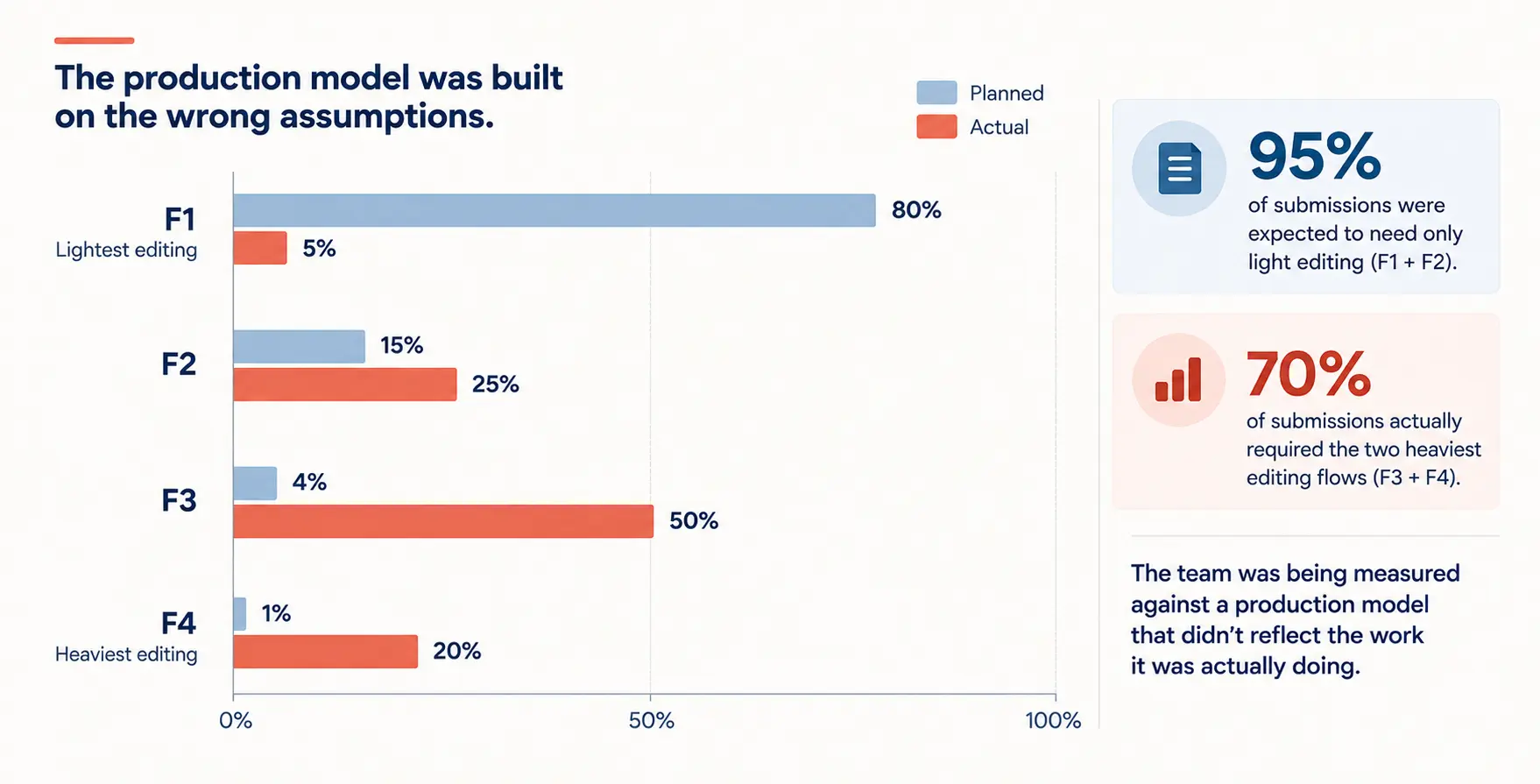
The production model also underestimated editing complexity:
Edit flow | Planned | Actual |
|---|---|---|
F1 — Lightest | 80% | 5% |
F2 | 15% | 25% |
F3 | 4% | 50% |
F4 — Heaviest | 1% | 20% |
Leadership expected 95% of submissions to need light editing. In reality, 70% required the two heaviest editing flows. The team was being measured against an unrealistic production model. Instead of replacing staff, I focused on defining editorial standards, measuring work consistently, and redesigning the workflow around actual demand.
03
THE INSIGHT
You can't manage quality against a standard that doesn't exist.
The audit revealed that editors and writers didn't share a consistent definition of what different levels of editing required.
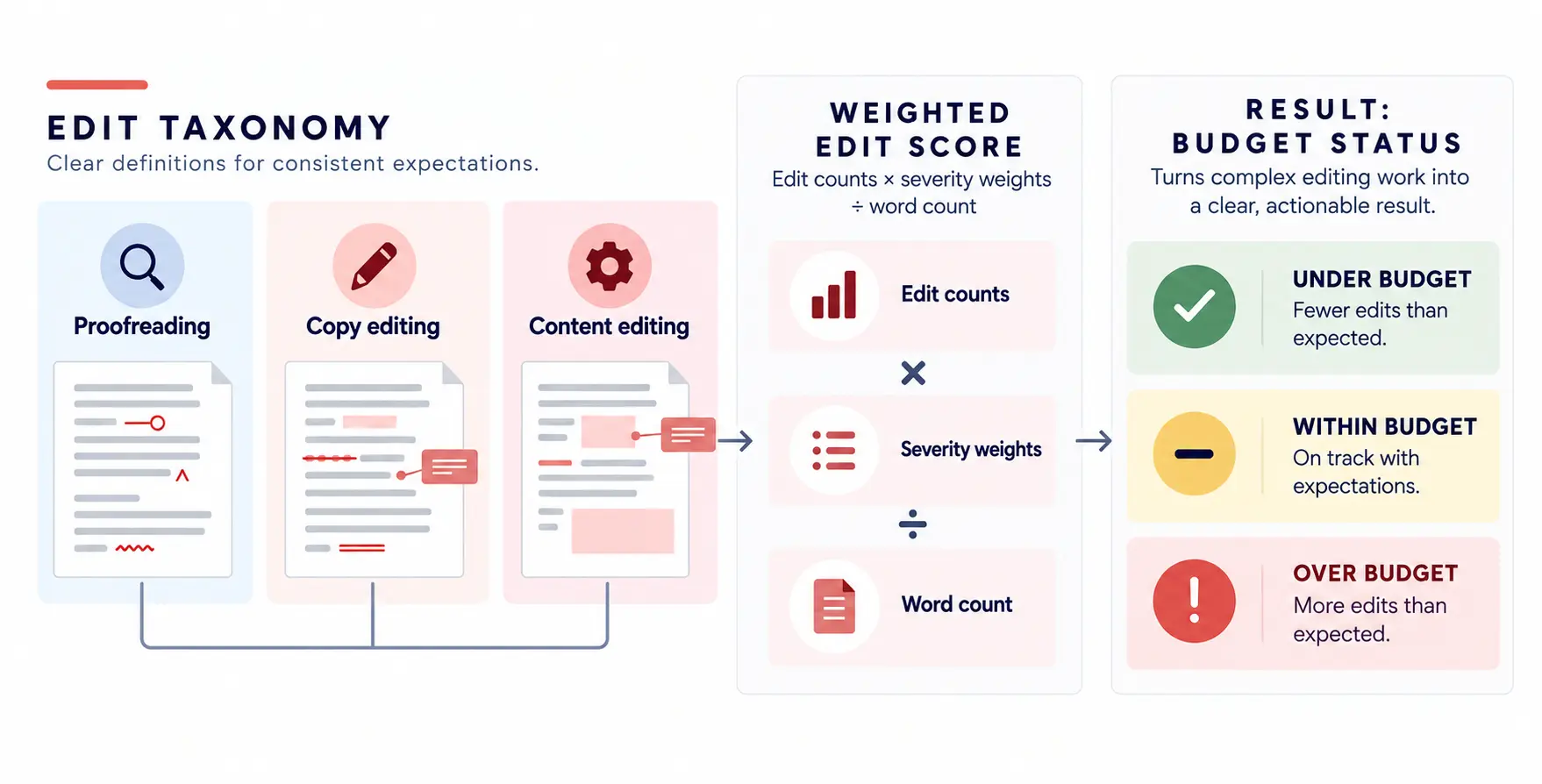
Proofreading, copy editing, and content editing were treated as loosely understood activities rather than distinct scopes of work. That ambiguity affected everything downstream: estimates, feedback, revisions, training, and accountability.
The solution wasn't simply to tell people to work faster or improve quality. I needed to make the quality standard explicit, measurable, and usable by everyone involved.
You can't blame a team for missing a bar that was never written down.
The breakthrough was to turn subjective editorial expectations into a shared operational framework.
Once the team could distinguish between edit types, assess work against consistent criteria, and identify why a submission exceeded its budget, quality became something the system could support rather than something individuals were expected to interpret independently.
04
THE SYSTEM
One editorial operating model connecting quality, cost, and production.
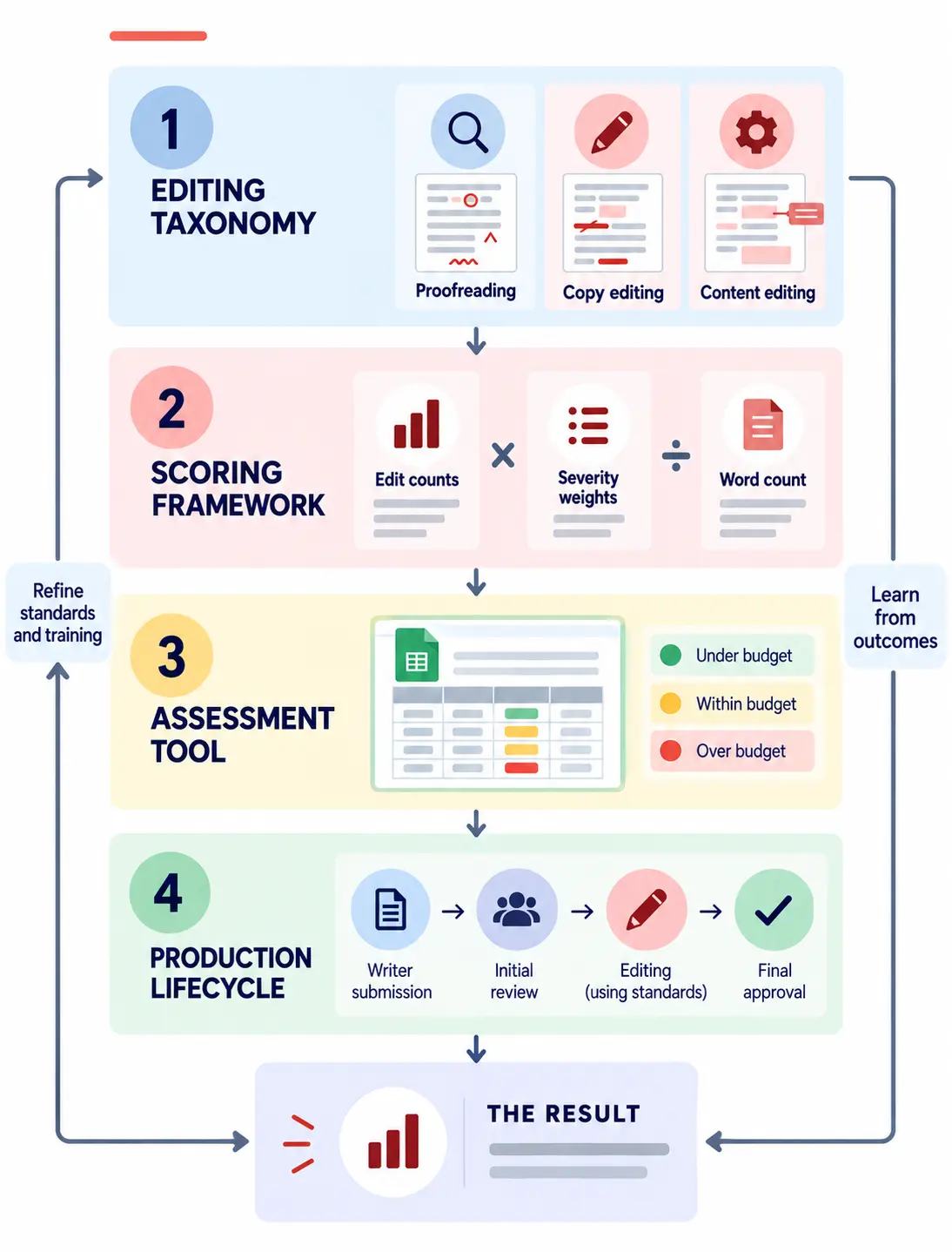
I redesigned the production workflow around four connected components:
Editing taxonomy: Defined proofreading, copy editing, and content editing to establish shared expectations.
Weighted scoring: Accounted for edit type, frequency, and word count to measure work consistently.
Assessment tool: Built a Google Sheets tool that calculated scores and flagged submissions as under, within, or over budget.
Production lifecycle: Reduced unnecessary meetings and clarifications while aligning workflows with actual editing demand.
Together, these components created a consistent system for defining quality, evaluating work, and managing production.
05
KEY DECISIONS
Design for accountability without turning measurement into punishment.
01
Define the work before measuring it.
I established consistent editing categories before introducing the scoring framework. Without shared definitions, a numerical score would simply give inconsistent judgments the appearance of objectivity. A metric can't fix an undefined standard.
02
Measure editing effort relative to submission size.
Raw edit counts weren't comparable across articles of different lengths or complexity. The weighted model accounted for edit types and word count, creating a more consistent basis for evaluating submissions and identifying work that exceeded budget. The score measured work against an editorial standard, not a person's worth.
03
Make the tool useful to writers, not just managers.
A scoring system introduced during a staffing crisis could easily feel like surveillance. I designed the taxonomy and assessment process around transparent criteria that writers could understand and use to defend their work. Results informed coaching and escalation rather than serving as an automatic disciplinary mechanism. Transparency was essential to adoption.
04
Redesign the workflow without stopping production.
The agency couldn't pause client delivery while I rebuilt its editorial operation. I introduced standards and process changes within the existing production cycle, prioritizing improvements that reduced repeated clarification and unnecessary coordination. The system had to work under real delivery constraints.
06
THE TRANSFORMATION
From subjective feedback to a shared production standard.
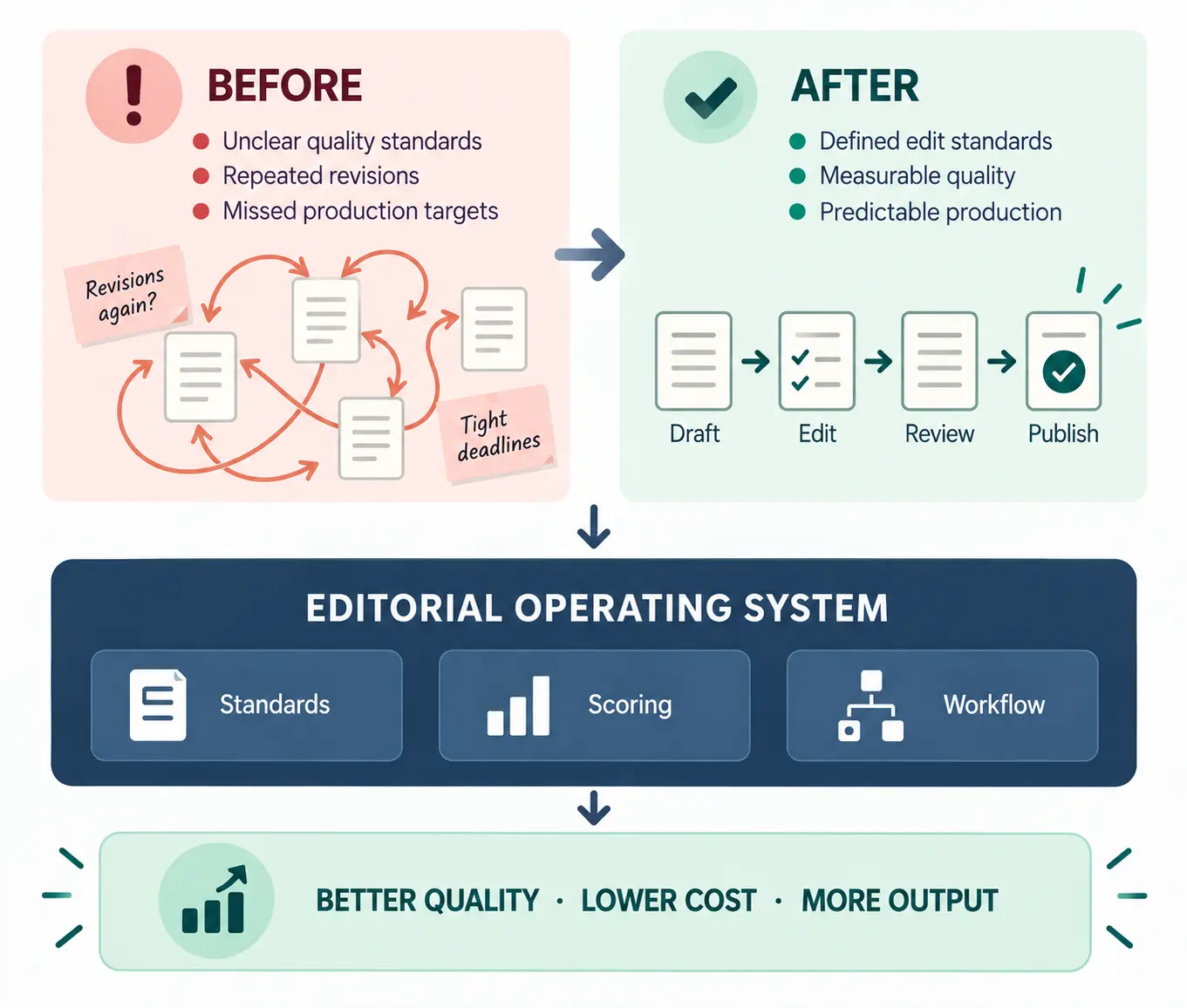
Before the redesign, writers and editors interpreted quality differently. Production estimates assumed light editing, while actual submissions required much heavier intervention. Revisions and clarification loops absorbed time without consistently improving the process.
After implementation, the team worked from defined edit categories, measurable thresholds, and a repeatable assessment workflow.
Editors could explain why work required additional effort. Writers had clearer expectations. Managers could distinguish between quality problems, process problems, and unrealistic production assumptions.
The system changed the conversation from “Who's failing?” to “What's happening in the workflow, and how do we improve it?”
BEFORE
Subjective production
Unclear standards
Inconsistent edits
Repeated clarification
Unpredictable cost
AFTER
Measured production
Defined standards
Consistent scoring
Targeted feedback
Predictable workflow
07
the outcome
Better quality. Less rework. More capacity.
Within three months of implementation, the redesigned system produced measurable improvements across quality and production. The average time per submission fell from 6.2 to 4.1 hours, while training and submission-related time dropped from 1.7 to 0.2 hours.
The results showed that the team could improve both quality and output when the production system provided clearer standards and removed unnecessary work.
These are observed outcomes from the redesign period. They demonstrate improvement under the new operating model, though the available figures don't isolate the contribution of every individual change.
"Quality complaints dropped, production sped up, and for the first time we're not double-checking everything before it reaches a client. "
— Managing Partner
08
What I Actually Designed
The system behind consistent editorial production.
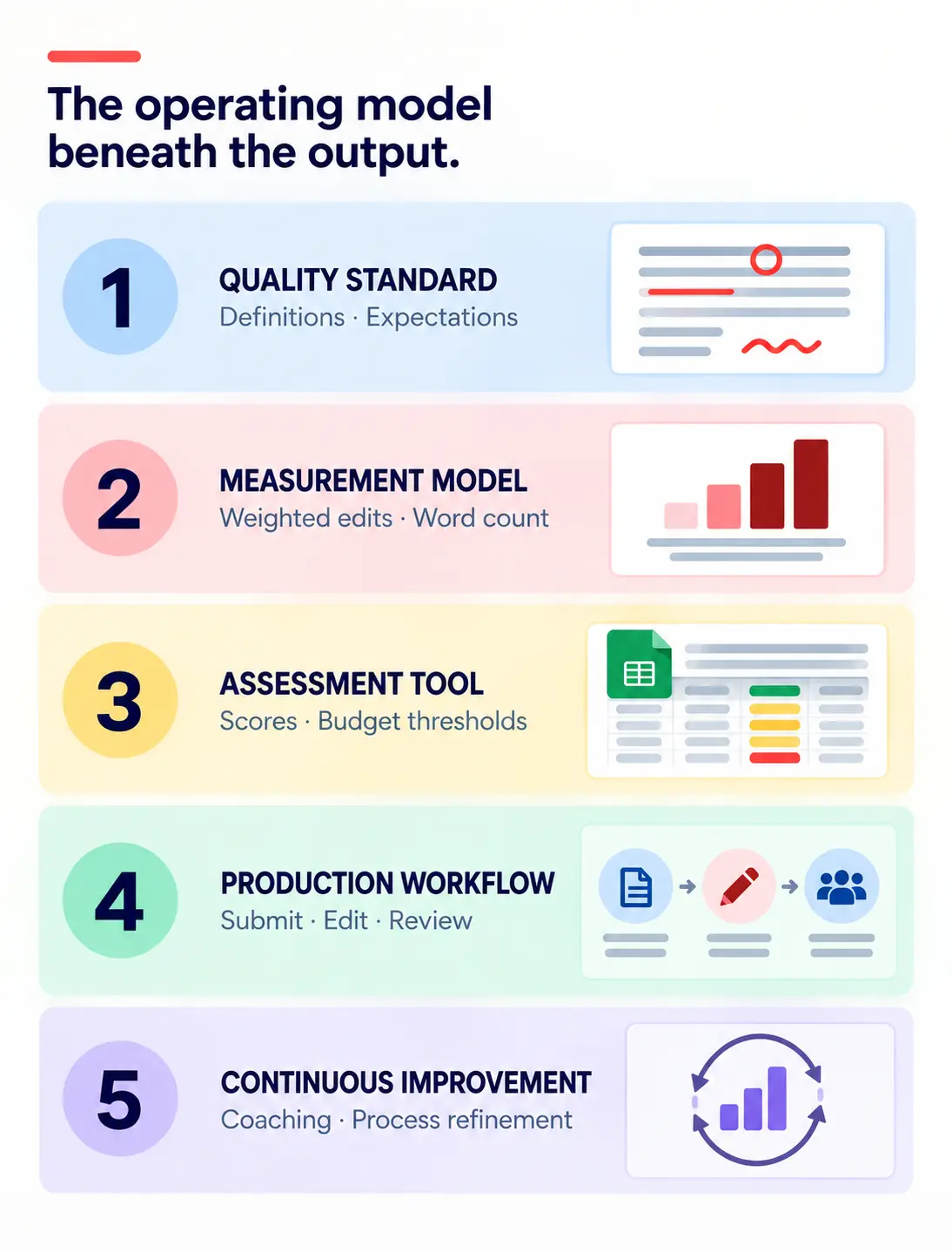
The visible output was a scoring tool and a revised workflow. The underlying work was designing an editorial operating model.
I defined the quality standard, translated it into a weighted measurement framework, built a tool that made the framework usable, and redesigned the production lifecycle around actual workload.
I also addressed the human side of implementation: making criteria transparent, supporting coaching, and introducing changes without disrupting client delivery.
The value wasn't making editors work faster. It was designing a system that made quality and efficiency achievable together.Risk-Impact Analysis
09
THE BIGGER IDEA
Fix the system before blaming the people.
When performance declines, replacing staff can appear to be the most direct response. But without understanding how work is defined, assigned, measured, and reviewed, a new team may inherit the same problems.
This project demonstrated the value of investigating the operating model before making staffing decisions. By making standards explicit and redesigning the workflow around actual demand, I helped create conditions in which the existing team could produce better work more efficiently.
You can't hold people accountable to a standard the system never defined.
10
Reflection
Measurement only works when people trust the standard behind it.
The most consequential decision was introducing a scoring system without turning it into a punitive performance tool.
A number can create clarity, but it can also create false certainty if the underlying definitions are inconsistent or people don't understand how it's calculated.
I started by defining the work, then built the measurement model and made its criteria transparent. That gave writers a clearer basis for understanding feedback and gave editors a more consistent way to explain their decisions.
The broader lesson was that operational improvement requires both system design and change management. A workflow can be mathematically efficient and still fail if the people using it don't understand or trust it.
If I revisited the project, I'd formalize ongoing calibration between editors and review the scoring thresholds periodically as content complexity and client expectations changed.
Want to see the actual error taxonomy, or how the escalation paths worked in practice? Reach out and I can go into the details!